How Much Gravel Do I Need Calculator for Driveways, Paths, and Gardens
When embarking on a construction or landscaping project, how much gravel do I need calculator one of the key materials you may need is gravel. Whether it’s for a driveway, a foundation, or a garden path, knowing how much gravel to purchase is essential to avoid overspending or running short. Fortunately, there are various calculators available that can help you determine the exact amount of gravel required for your project.
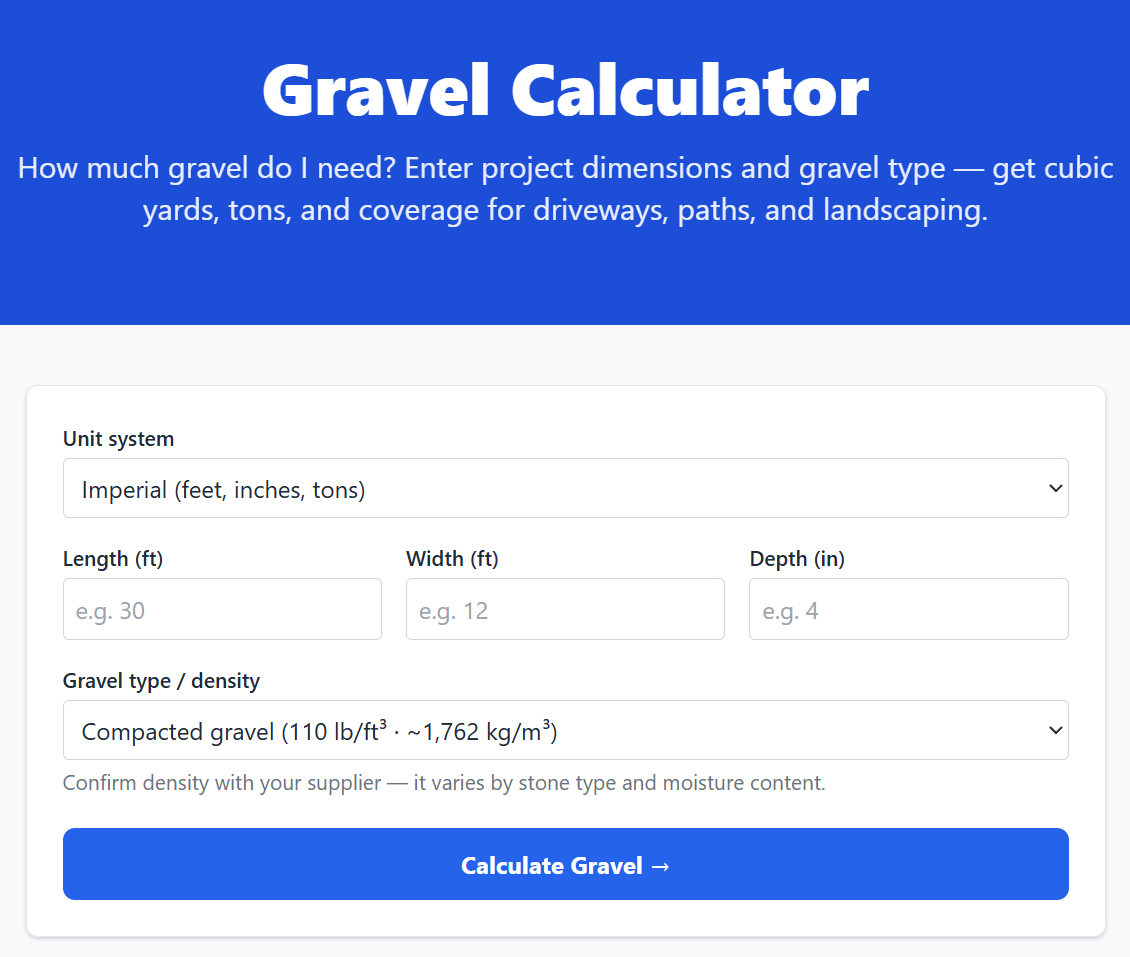 To begin with, gravel calculator understanding the dimensions of the area you plan to cover is crucial. Start by measuring the length and width of the space where you intend to lay the gravel. If the area is not a perfect rectangle, you may need to break it down into smaller sections, calculate each section's area, and then sum them up.
Once you have the total area in square feet, you will need to decide on the depth of the gravel layer. This depth can vary depending on the intended use; for example, a driveway may require a depth of 4 to 6 inches, gravel coverage calculator while a garden path might only need 2 to 3 inches. It’s important to note that the depth will significantly affect the total volume of gravel needed.
After determining the area and depth, you can calculate the volume of gravel required. The formula for calculating the volume in cubic feet is as follows:
Volume (cubic feet) = Area (square feet) x Depth (feet)
For instance, if you have an area of 100 square feet and you want a depth of 4 inches (which is approximately 0.33 feet), the calculation would be:
Volume = 100 sq. ft. x 0.33 ft = 33 cubic feet.
Once you have the volume in cubic feet, you may want to convert it to cubic yards, as gravel is often sold by the cubic yard. To convert cubic feet to cubic yards, divide the total volume by 27 (since there are 27 cubic feet in a cubic yard):
Cubic Yards = Volume (cubic feet) / 27
Continuing with our previous example:
Cubic Yards = 33 cubic feet / 27 = 1.22 cubic yards.
Now that you have the amount in cubic yards, it's wise to round up to account for settling and compaction, especially if you are working with loose gravel. Therefore, gravel calculator for landscaping you might consider ordering 1.5 cubic yards to ensure you have enough material.
Many online calculators simplify this process by allowing you to input the dimensions and depth directly. These calculators will automatically compute the required volume and even provide estimates for the cost based on local gravel prices. This can save you time and reduce the risk of errors in manual calculations.
In conclusion, understanding how to calculate the amount of gravel needed for your project is essential for effective planning and budgeting. By measuring the area, deciding on the depth, and using the appropriate formulas or calculators, you can ensure that you order the right amount of gravel for your needs. Remember to account for settling and compaction when making your final order, and consider consulting with a local supplier for additional guidance on gravel types and costs. With the right preparation and tools, you can make your project a success.